Two Children, One Child: When Home and School Describe Different Kids
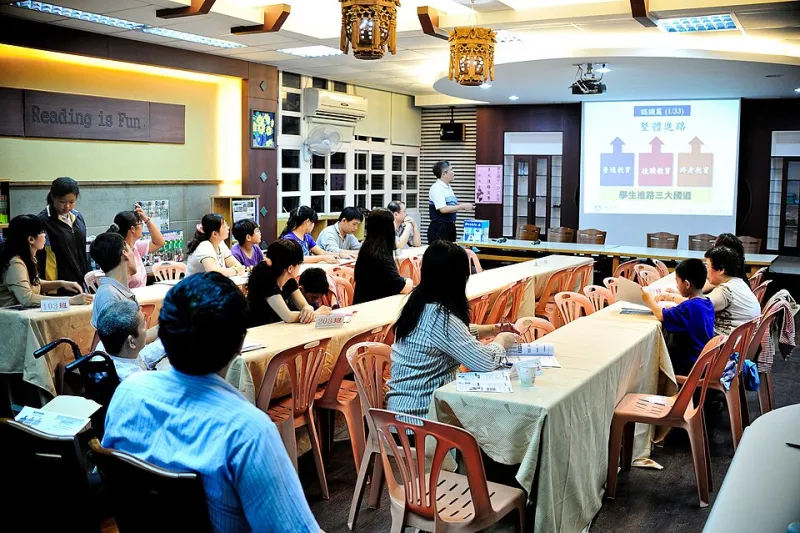
Photo: 褒忠國中 雲端網, CC BY 2.0, via Wikimedia Commons
There's a sentence that shows up in almost every UK clinic room, school meeting and annual review: "He's absolutely fine at home." Or its mirror image: "She's fine at school — I honestly don't know what the problem is at home."
Both statements are usually accurate. That's the awkward part. And it's exactly why so many referrals stall.
Two honest accounts of the same child
When a class teacher says a pupil "copes well" and a parent describes nightly meltdowns, nobody is exaggerating. You're looking at a child whose capacity is being spent in one place and whose recovery happens in another.
Children who mask are doing enormous work: tracking social rules, suppressing stims, monitoring tone, holding tears in until the car door shuts. Some families call the result "after-school restraint collapse." It isn't manipulation, and it isn't proof that home is the problem. It's the cost of holding it together somewhere that doesn't yet flex around them.
The gap between settings is itself useful information. It tells you where the demands are, what support already exists, and what a child can manage when they feel safe.
Why the gap opens up
A few of the everyday reasons presentations differ:
- Masking and camouflage. Some children learn early that fitting in is safer than being noticed.
- Different sensory load. A busy classroom, a noisy dinner hall, a crowded playground — all of it costs energy. Home is often quieter.
- Demand and autonomy. Some children find instructions and transitions disproportionately hard, and the drive for control tends to show most where a child feels safest.
- Adult tolerance thresholds. Two classrooms can hold very different ideas about what counts as disrupted learning.
- Snapshot versus story. School sees a child for six hours among thirty peers. You see the whole week.
- Exhaustion, hunger and sleep. The 4pm window is not a neutral one.
Build evidence in parallel, not in competition
The most useful thing you can do before a GP appointment, a paediatric review or a SEND meeting is to stop the two accounts competing and start collecting them side by side. The absence of difficulty at school is information — it is not evidence that there is no need.
Try a shared two-week diary with identical headings in both settings: sleep, food, transitions, what happened just before a hard moment, what helped, what it cost afterwards. Ask school to add short notes rather than a polished summary. Written observations from the SENCO are worth requesting politely by email; verbal reassurances at parents' evening vanish, whereas an email stays in the folder.
Photos, annotated work, a note of the mornings that took forty minutes, the club your child has quietly started avoiding — all of it fleshes out the picture. If you've already put together a one-page child profile (our earlier guide walks through it), this diary is the natural companion piece.
What to say when the room splits
Some phrasing that tends to keep conversations productive:
- "He presents very differently in different settings. We think that gap is part of the picture, not a contradiction."
- "School sees a child managing well. We see the recovery. Both are true, and we'd like them recorded together."
- "Can we write down what she can do with support, not just what she can do without it?"
Resist defending one version of your child against the other. It's rarely a case of a lying parent or a negligent school — more often it's a child with a narrow margin between coping and not coping.
When the two sides genuinely disagree
If a setting insists there's nothing to see, ask in writing for their observations to be included in any referral. Ask what staff notice around transitions, group work and unstructured time; those answers are often more revealing than a general "he's fine."
If you believe needs aren't being met, you can ask the local authority to carry out an EHC needs assessment, and the local offer will explain how. SENDIASS services provide free, independent advice on that process. A GP or paediatrician can also seek information from school directly, which sometimes carries more weight than a parent's account alone.
Don't lose sight of the person at the centre
Somewhere between the log sheets and the meeting minutes is a child who has been working very hard. If there's a safe adult at school, that relationship is worth protecting. Ask your child — gently, sideways, perhaps in the car — which parts of the day are hardest and which adults help. Their answer may not match either setting's version, and it deserves a place in the notes too.
The short version
Different children in different places isn't a contradiction to be resolved. It's a pattern to be described. Gather both stories, lay them side by side, and say plainly: this is one child with a limited supply of coping, and the gap tells us where support is needed.